Humahuaca
Town located to the north of San Salvador de Jujuy, at 2,939 meters above sea level, in northwestern Argentina. Until the end of the 19th century it was one of the most important colonial commercial centers on the old road to Upper Peru. In it, its narrow and cobbled streets stand out, worth walking on foot, with its low adobe houses preserving their historical physiognomy.
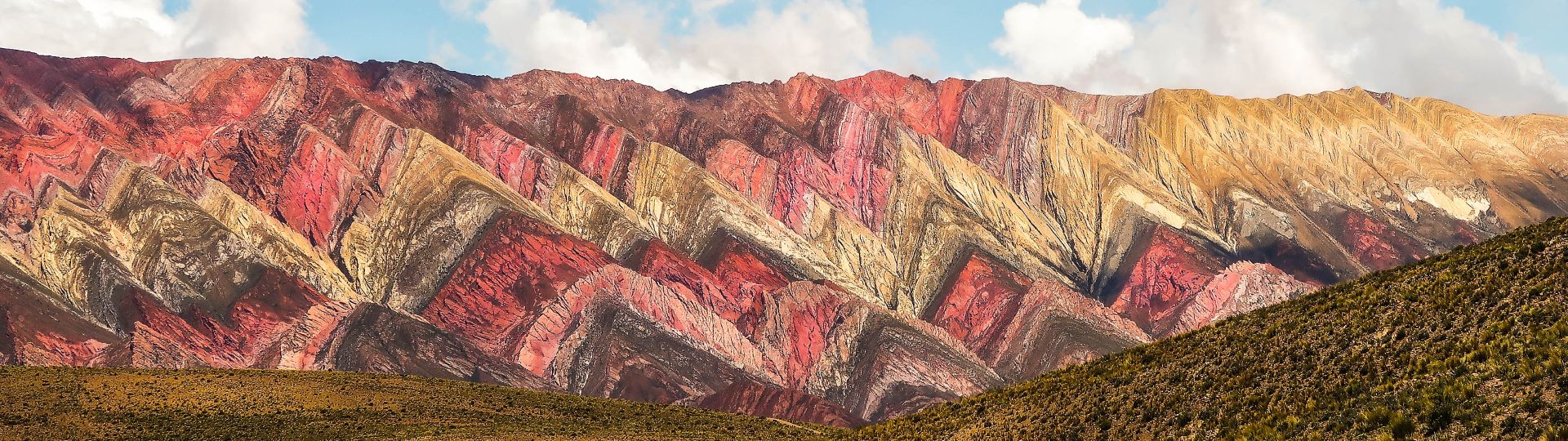
But what has really made this area famous is "La Quebrada de Humahuaca", an Andean valley stretching for 155 km flanked by high mountain ranges and painstakingly carved by the Rio Grande through more than 2,000 meters high. It was declared a World Heritage Site by UNESCO on July 2, 2003. It presents a marked north-south course, with increasing altitude in its northern zone and for this reason it is considered a natural access route to the Altiplano. Being a route used since pre-Columbian times, it has been part of a multicultural route for thousands of years. Aborigines of different ethnic groups walked along its trails and still today preserve religious beliefs, rites, festivals, art, music and agricultural techniques that are a heritage. living. The Humahuaca ravine served as a route for the Incas, it was an obligatory passage for expeditionaries and colonizers and an important commercial route in the viceroyalty period. The towns of the colonial era acquired great importance since they developed together with the ancestral settlements of the place, in addition to producing a cultural exchange with neighboring territories in South America. Its true importance lies in the fact that the ravine has functioned as a permanent channel of interaction, linking distant and different territories and cultures, from the Atlantic to the Pacific and from the Andes to the southern plains. It was also the scene of many battles fought during the War of Independence and during the war before the invasion of the Peruvian-Bolivian confederation.
The towns of this ravine link history and traditions of ancestral roots, being the ethnic group Quechua is the most prevalent today, Quechuas descendants of the ancient settlers, self-proclaimed original peoples and who live coexisting with nature, Pachamama (Mother Earth), the Sun God, the God of Thunder, lightning and with all beings alive whom they respect. Among its attractions is the monolith that indicates the crossing of the Tropic of Capricorn and the Pucará de Tilcara, a fortification built by the primitive settlers erected on top of the mountains.